
We’re creating a world
without tailings dams
Tailings dams are expensive liabilities that present unacceptable levels of risk.
We partner with mining companies to economically rehabilitate their tailings
to unlock value, clean the water, and restore the land.
Tailings management
has changed
Tailings are an inevitable part of mining but it’s no longer acceptable for them to be a waste product that pollutes the land and water.
They are expensive to store and manage, a balance sheet liability, and a threat to the environment and local communities.
This is not sustainable.
Some mining operations have unlocked their tailings. Changing them from a liability into a valuable asset. They have found efficient ways to extract the valuable metals, clean the water, and restore the land.
Mining needs
to evolve
The cost of sticking with the current approach to tailings management is immense and growing.
Tailings dams continue to threaten communities around the world.
Tailings storage ties up land and water, which could be reused or repurposed, and needs to be managed and monitored for
at least decades. Not only is it expensive, it creates huge balance sheet liabilities.
Also, valuable precious metals and critical minerals remain unrecovered in tailings. This is wasteful and inefficient.
With mining operations built around maximising net present value, the “fight” for capital means economic recovery of metals from tailings is deprioritised.
-
-60%
new discoveriescompared to 30 years ago, despite 3x higher exploration expenditure -
20%
capital expenditurein realised projects, compared to budget or forecasted amount -
-11$Bn
y-o-y investmentin Greenfield projects until 2026 due to a lack of approved and financed new projects
There’s far more value tied up in tailings than most mining companies realise
Miners who fully adopt the economic rehabilitation of tailings will become the natural owners of the growth of our industry.
When done properly, this process eliminates risks and liabilities. It unlocks the value of the wasted metals and creates new sources of revenue from repurposed land and water.
Smart miners will create more sustainable, more profitable businesses that are safer and cleaner for everyone around them. With a stronger balance sheet and enhanced social license, they can expand operations more easily, moving towards a world with no tailings dams.
-
283
Billion tonesEstimated tailings in 8,500 active, inactive and closed storage facilities: -
79 %
Estimated tailings in 8,500 active, inactive and closed storage facilities:
Create sustainable sources of metals & minerals
Our economic rehabilitation process transforms tailings into beneficial elements. It removes contaminants to take care of legacy issues for mine closure, separates solids and water for recycling, then returns them to their source.
Traditional
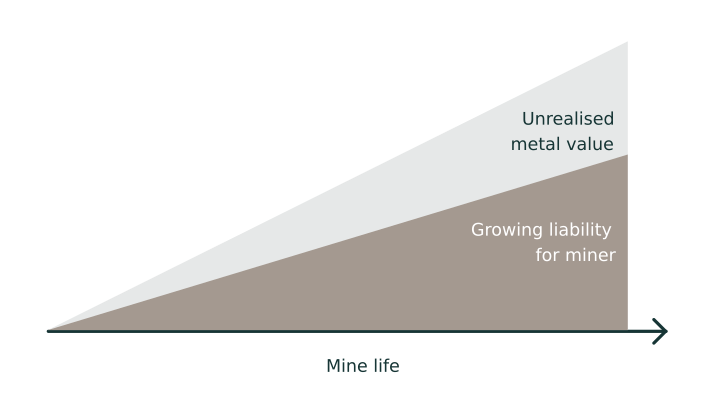
rehabilitation:
Deferring rehabilitation increases the risk of closure time extension and (potentially uncapped) costs due to regulatory changes
Lost opportunity: Once rehabilitated, the costs to recover valuable metal and the permitting to re-disturb site can make tailings metal recovery uneconomic
Economic
rehabilitation
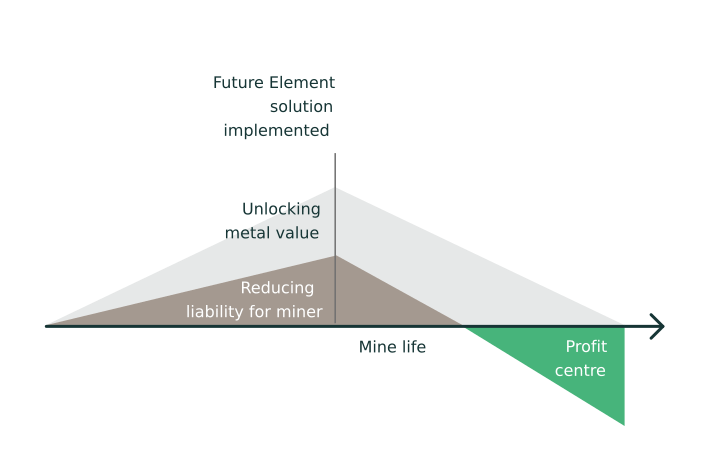
model:
Progressive and economic rehabilitation of tailings reduces costs for tailings storage & final rehabilitation, accelerates mine closure, and provides a path to reduce environmental bonding and balance sheet liabilities for mining companies
Remnant value of metal in tailings dam is recovered and used to offset costs for rehabilitation. Depending on metal value, the aim is to produce net profit from tailings
A new way to manage tailings
You can now unlock your tailings to offset costs. Not only can you profitably recover precious metals and minerals, but you can repurpose the water and solids to enhance host communities.
The full potential of economic rehabilitation extends far beyond the metal, land, and water produced from tailings:
- A positive legacy, enhancing reputation with all stakeholders
- Sustainable metals from tailings and water
- Offset costs & turn tailings into a profit center
- Fully-funded services, taking rehabilitation off balance sheet
Service offering
There’s a simple way for you to progressively rehabilitate your site and recover valuable metals from your tailings at the same time.
Partnering with us gives you access to our proven execution model and we manage and fund the entire process for you.
Our team has a strong track record of developing, funding, and operating New Century mine and deep understanding of all aspects of mining operations.
-
Tailings & waste transportlearn more
Traditionally it was difficult to recover useful elements from tailings. We now have the right combination of technology and expertise to make this easy and profitable.
Our metal recovery, rapid dewatering, and low-energy water treatment technologies are safe and proven at other operations. And they won’t disrupt your current operations.
-
Metal & mineral recoverylearn more
Remnant metals economically recovered to offset tailings or final deposition costs
Remove environmentally harmful tails/water content
Products integrated with current streams or new products created
Including:
- Hydraulic mining
- Dredging
- Truck & shovel
-
Dewatering & depositionlearn more
Optimised technologies for dewatering and deposition in the final location
Integrated solutions with current operations to ensure tailings footprint is minimised and backfill is maximised
Including:
- Advanced Dewatering
- Optimised Backfill
- Dry Stacking
-
Water treatment & recoverylearn more
Good water management is crucial to reputation and sustaining mining operations in an increasingly volatile climate
Combination of water recycling and targeted/customised water treatment employed
Including:
- Metal recovery
- Contaminant removal
- Evaporation
-
Rehabilitation & repurposinglearn more
Based on closure plan and land release requirements, disturbed areas will be rehabilitated using best-in-class practices, revegetation, and continuous monitoring practices
Including:
- Land formation
- Cap & Revegetation
- Repurposing
Service scope
We’re responsible for the complete scope from concept development through to operational execution and ultimate relinquishment.


Commercial model
We move tailings management and rehabilitation off your balance sheet via one of two contract structures, customised for each project:
Services + Metal Recovery
Services (only)
Contract structure
Fee-based (fixed / variable cost basis)
Future Element
Future Element
Agreed key performance metrics
Life of tailings
Life of tailings
Long-term contract (life of tailings)
JV (% equity ownership by client and Future Element)
Future Element
Commercials
Operating profit
Distributed to Joint Venture shareholders
Distributed to miner, less payments to Future Element
Saleable products
Sold by Joint Venture either to client or to third party
Sold by client
Future Element remuneration
Distribution from JV
Base operation fee plus performance-based payments
Operating cost accountability
Joint Venture
Future Element, with agreed key performance metrics
Capital
Capital contribution, incl. working & sustaining capex
Relative to % ownership of JV
By Future Element
Capital payback
Potential for loan-carry between JV shareholders
Built into contract, payments to Future Element for capital payback
Environmental bonding & liability
Liability ownership and bonding responsibility1
Remains with mining company
Remains with mining company
- Revenue from metal recovery offsets rehabilitation costs
- Increases site reportable metal production
- Allows flexibility in fee structure and funding options via metal exposure
- Single-source accountability for tailings and water management
- KPIs structured to minimise cost and maximise rehabilitation
Technology & Partners
We’re partnering with top-tier miners, mining technology companies and OEMs to provide robust, adaptable & autonomous solutions.
-
 Metal recovery, advanced dewatering and water treatment platform technologies cleanteqwater.com
Our team
-
-

John Carr
Managing Director & CEO
learn moreCo-founder and Chief Development Officer of New Century Resources, responsible for project acquisitions and development strategies
Through this process, the Company established one of the world’s largest tailings reprocessing operations at the Century Mine in just 18 months
Previously, Executive General Manager of Mining at Sunrise Energy Metals, for the acquisition and development of the Sunrise laterite project. Prior to this role, John held senior commercial and technology management roles for a range of metals. Previously, technical roles at Rio Tinto
MBA and a Bachelor in Chemical Engineering -

Patrick Walta
Director
learn moreFounding Managing Director of New Century Resources, leading growth of the Company though mine restart and steady state operations
Through this process, the Century Mine became the world’s 13th largest zinc producer, delivering >1Mt of zinc concentrate from tailings reprocessing
Previously, Managing Director of Carbine Resources, CEO of Cradle Resources and various technical roles, with extensive experience in metal extraction
MBA, Masters of Mineral Economics, Bachelor in Chemical Engineering and Science and Australian Institute of Company Directors -

Dennis Gibson
CTO
learn moreOver 40 years international mining experience including with Rand Mines and 20 years with Rio Tinto in various operational and strategic roles, including global Rio Tinto water strategy. Executive Committee member with ASX listed Energy Resources of Australia.
Former Chief Technical Officer Mining with global engineering, consulting and construction firm Black & Veatch. Dennis has provided strategic market entry advice to clients leveraging his vast international experience, deep industry knowledge and extensive networks. MBA and Bachelors and Masters degrees in Engineering -

Brent Slattery
COO
learn more18 years working in the mining industry as a senior leader and consultant
Previously 12 years at BHP in a range of operational & commercial leadership roles in the Coal, Copper & Iron Ore groups including Group Manager for automatous mining as well as responsibility for the Caterpillar relationship globally.
More recently Brent was with Boston Consulting Group as an expert their Industrial Goods & Operations Practices. His focus was operational turnarounds, major capital delivery and operating model transformations
Executive MBA and Bachelor degrees in Mechanical Engineering and Business
-
Insights
Contact